
Grass-Fed Beef Certification and Labeling: What Do They Really Mean?
Understanding grass-fed beef certification and labeling is essential for consumers who want to know what they are buying and ensure they are supporting genuinely grass-fed production practices. The absence of consistent regulation, the presence of third-party certifiers, and the variety of marketing terms can make grass-fed beef labels confusing. This article explains the key dimensions of certification and labeling, helping buyers make informed decisions that align with their values regarding health, environment, and animal welfare.
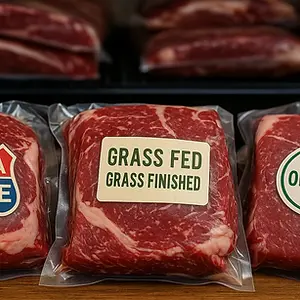
What Does “Grass-Fed” Mean on a Label?
The term “grass-fed” on a beef label means the animal's diet primarily consisted of grass and forage after weaning, but definitions can vary widely between certifying bodies. Many consumers assume "grass-fed" means 100% grass-based diets and natural pasture raising, but labeling rules allow room for interpretation depending on certification or marketing claims.
This is where it’s helpful to understand the difference between grass finished and grain supplementation. It is important to distinguish between labels stating "grass-fed" and those specifying "100% grass-fed," as partial grass diets supplemented with grains can still sometimes be marketed under ambiguous labels.
According to the USDA’s Agricultural Marketing Service, grass-fed labeling does not always imply exclusivity of forage-based diets unless explicitly stated (“United States Standards for Livestock and Meat Marketing Claims—Grass (Forage) Fed Claim for Ruminant Livestock and the Meat Products Derived From Such Livestock,” USDA, 2007).
Who Regulates Grass-Fed Beef Labels?
Grass-fed beef labels are regulated in part by the United States Department of Agriculture (USDA), but much of the oversight today falls to independent third-party organizations.
The USDA previously had a formal standard for grass-fed claims but withdrew it in 2016, leaving certification largely voluntary.
Today, producers can self-claim "grass-fed" with minimal federal verification unless they choose independent certification, adding complexity to the marketplace.
Is Grass-Fed Beef Always Certified?
Not all grass-fed beef is certified, and certification remains optional for most producers.
Many smaller farms rely on direct consumer trust rather than paying for third-party verification, particularly when selling through local farms and ranches or farmers markets, CSAs, or direct delivery.
The lack of certification does not automatically mean the beef is not genuinely grass-fed, but it places a greater burden on consumers to research and ask questions.
Understanding the USDA Grass-Fed Standard
The USDA introduced an official grass-fed marketing claim standard in 2007, requiring cattle to be fed only grass and forage, but this standard was withdrawn in 2016. Producers could no longer receive a USDA certification label without additional third-party auditing, even though claims like "USDA Process Verified" may still appear on packaging.
Understanding the nuances of the old USDA standards helps buyers recognize the difference between government-verified and self-declared labeling. The dissolution of this standard left a regulatory gap that has since been filled by independent certifiers. According to the USDA's Agricultural Marketing Service, the withdrawal was due to the agency's determination that it lacked the statutory authority to develop such marketing claims (“Understanding AMS' Withdrawal of Two Voluntary Marketing Claim Standards,” USDA, 2016).
To better understand how the USDA’s role in grass-fed labeling has evolved, here’s a timeline showing key changes over time:

What Is Third-Party Grass-Fed Certification?
Third-party grass-fed certifications provide more reliable verification for grass-fed claims than self-declarations. Organizations like the American Grassfed Association (AGA) and Food Alliance audit producers on strict standards, ensuring 100% grass-based diets, no feedlots, and often additional animal welfare considerations. Research published in Third-Party Certification, Sponsorship, and Consumers' Ecolabel Use (Journal of Business Ethics, 2018) shows that consumers perceive third-party labels as significantly more trustworthy than self-made marketing claims.
To compare leading third-party grass-fed certifications at a glance, here’s a side-by-side breakdown of what each label requires:

What Other Labels Should Consumers Look For?
Several additional labels often accompany grass-fed claims, and understanding them is critical to avoid confusion:
• Organic: Refers to feed and farming practices but does not guarantee a 100% grass diet.
• Pasture-Raised: Implies outdoor access but not necessarily grass-only diets.
• No Hormones/No Antibiotics: Health claims that are separate from grass-feeding standards.
Consumers must read labels carefully because different certifications or claims prioritize different aspects of production.
How Can Consumers Tell If a Grass-Fed Label Is Legitimate?
Consumers can evaluate the legitimacy of grass-fed claims by:
• Looking for third-party certifications such as AGA.
• Scanning QR codes or looking up producers online for detailed transparency.
• Asking direct questions about feed and finishing practices when buying from local farmers.
Signs of vague or inconsistent information should raise caution for buyers committed to authentic grass-fed beef.
Why Do Labeling Standards Matter for Animal Welfare and Health Claims?
Labeling standards directly impact consumer trust in claims about animal welfare, nutritional quality, and environmental stewardship. Misleading labels can cause buyers to support systems they intended to avoid, such as feedlot finishing or grain-finished diets.
Clear certification ensures that purchasing decisions reinforce the intended ethical and health values behind buying grass-fed beef. Studies have confirmed that consumers associate certified grass-fed labels with higher animal welfare and health and wellness benefits such as improved fat profiles (Consumer Perceptions, Preferences, and Behavior Regarding Pasture-Raised Livestock Products: A Review, Food Quality and Preference, 2020).
What Are the Legal Implications of Grass-Fed Labeling?
Incorrect or deceptive labeling claims expose producers to legal risks under false advertising laws, enforced by agencies like the Federal Trade Commission (FTC).
Several lawsuits and regulatory actions have highlighted the importance of accurately representing grass-fed claims.
Producers must align marketing language with verifiable production practices to avoid costly legal and regulatory disputes.
Should You Trust Local or Direct-Market Grass-Fed Beef Without Certification?
Buying local, uncertified grass-fed beef often relies on personal trust rather than third-party verification.
When consumers develop relationships with ranchers and can inspect production practices firsthand, certification may be less critical.
However, for buyers unfamiliar with the producer, third-party certification offers an important layer of protection and peace of mind.
From Labels to Buying Decisions
For those ready to move beyond label reading and actually purchase, understanding the different buying options can further empower your decision-making. Whether you're interested in a whole cow, a half share, a quarter, or even an eighth, each option offers varying quantities, price points, and freezer space requirements. Knowing what to expect from these purchase sizes helps align your values with a practical buying choice.
Conclusion
Certification and labeling are critical tools for helping consumers know they are buying authentic grass-fed beef.
While third-party certifications offer the highest level of assurance, understanding the language on labels and verifying producer practices can empower buyers even when certifications are absent.
As awareness grows, labeling will continue to shape the future of grass-fed beef markets, consumer trust, and ethical food production.
2025-12-09
2026-2-17
Sources:
United States Department of Agriculture, Agricultural Marketing Service. “United States Standards for Livestock and Meat Marketing Claims—Grass (Forage) Fed Claim for Ruminant Livestock and the Meat Products Derived From Such Livestock.” Federal Register, vol. 72, no. 199, 16 Oct. 2007, https://www.federalregister.gov/documents/2007/10/16/E7-20328/united-states-standards-for-livestock-and-meat-marketing-claims-grass-forage-fed-claim-for-ruminant. United States Department of Agriculture, Agricultural Marketing Service. “Understanding AMS' Withdrawal of Two Voluntary Marketing Claim Standards.” USDA Blog, 20 Jan. 2016, https://www.usda.gov/about-usda/news/blog/understanding-ams-withdrawal-two-voluntary-marketing-claim-standards. Darnall, Nicole, et al. “Third-Party Certification, Sponsorship, and Consumers' Ecolabel Use.” Journal of Business Ethics, vol. 150, no. 4, 2018, pp. 953–969. https://doi.org/10.1007/s10551-016-3138-2. Stampa, Ekaterina, et al. “Consumer Perceptions, Preferences, and Behavior Regarding Pasture-Raised Livestock Products: A Review.” Food Quality and Preference, vol. 82, 2020, Article 103872. https://doi.org/10.1016/j.foodqual.2020.103872.